Skip to content
Indent

v0.1.0A desktop app. No account, no server.

Learn to code by fixing real problems

Each repo is a small company with a problem, and you are its developer. Read a short lesson, write the code in a real editor, run it in a real terminal, and press Check.

15 repos, 70 issues, 207 tasks. All of it on your disk.

3 of 3 tasks pass
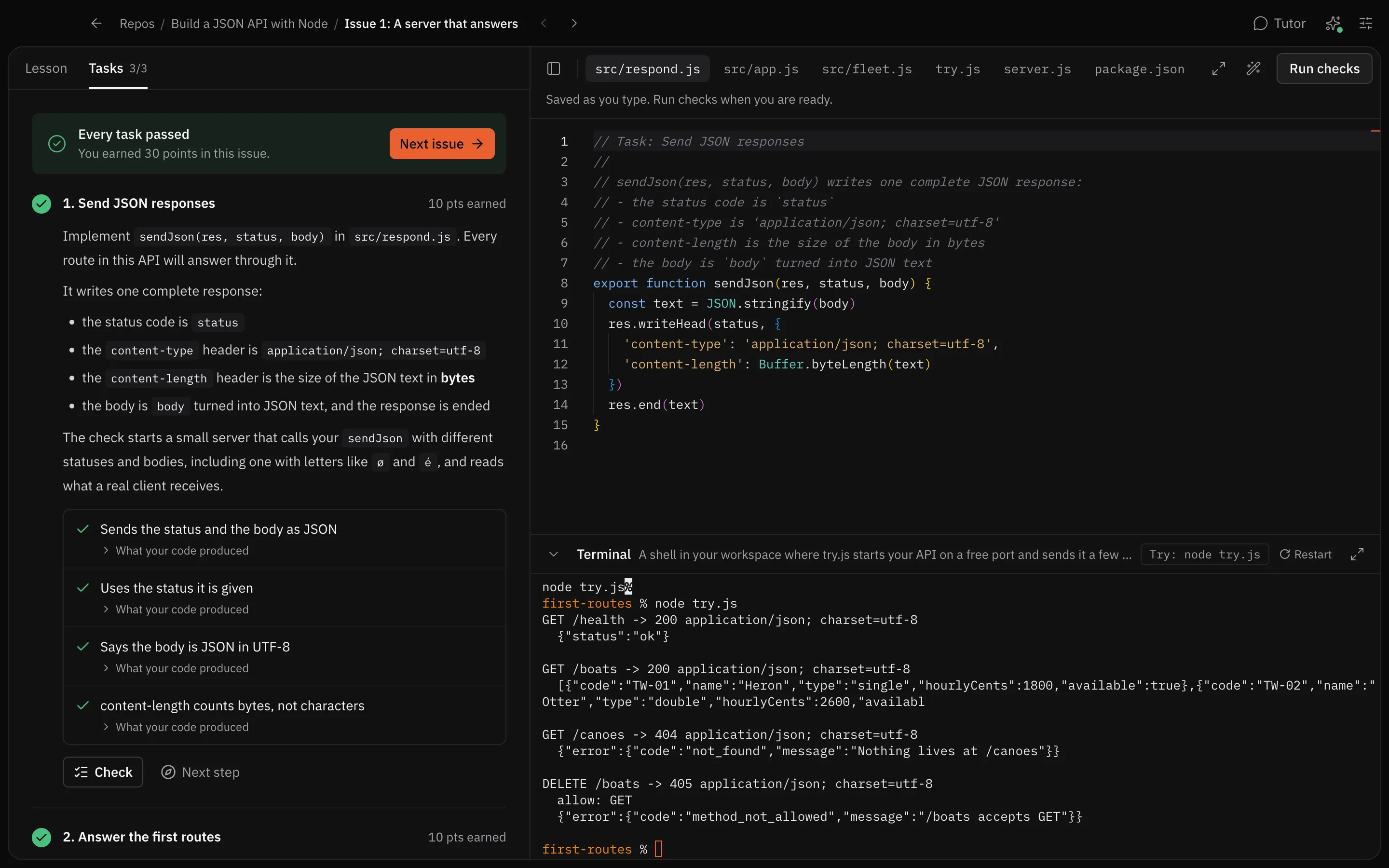
The Indent workspace: the tasks of the issue A server that answers, all three passed, next to src/respond.js in the editor.
The workspace after every task of an issue has passed.

/repos

15 small companies with a problem. You are the developer they just hired.

A repo is a story told through its issues. An issue is a short lesson and a few tasks, and every task is checked by hidden tests. Pick the one that matches what you want to get good at.

Repos
15
Issues
70
Tasks
207
Hints per task
3
  • TSAI engineering

    Build an agent by hand

    Pebble Lane Pantry, a neighbourhood grocer that delivers by cargo bike, wants an assistant called Pip that can look up orders, check shelves and issue refunds.

    5 issues, 15 tasks
  • TSAI engineering

    Evals: measure before you ship

    Pebblebrook Plants routes every support email through a language model, and nobody can say whether the next change will make it better or worse.

    5 issues, 15 tasks
  • TSAI engineering

    LLM apps from scratch

    Fernhollow is a small plant shop that wants an assistant called Moss to help with care questions, a busy inbox and order emails.

    5 issues, 15 tasks
  • TSAI engineering

    LLM bug hunts

    You just joined Kestrel Parcels, a same-day courier whose support assistant runs on a language model.

    3 issues, 9 tasks
  • TSAI engineering

    Retrieval from scratch

    Saltmarsh Paddle Co. hires kayaks from a harbour quay, and its front desk answers the same handbook questions all summer.

    5 issues, 15 tasks
  • SQLDatabases

    SQL for everyday questions

    Brindle Bakehouse bakes bread and cakes for a dozen cafes along the coast, and every order sits in a small SQLite database nobody has learned to query.

    5 issues, 15 tasks
  • SHDevOps and tools

    Git rescues

    You look after the code at Gullwick Ferries, a small island ferry company whose timetable, fares and tools all live in one repository.

    5 issues, 12 tasks
  • JSInterview bug cases

    JavaScript bug hunts

    You are the only developer at Cinderbay Paddle Co., a kayak and paddleboard rental on the harbour, and the bug reports have started to pile up.

    5 issues, 15 tasks
  • JSJavaScript and TypeScript

    Async JavaScript without surprises

    Tidewell Ferries runs three small boats between the quay and two islands, and every screen in its ticket office waits on a slow, unreliable service.

    5 issues, 15 tasks
  • JSJavaScript and TypeScript

    Build a JSON API with Node

    Larchmere Kayaks rents boats from a shed on Lake Marrow, and its bookings still live on a whiteboard.

    5 issues, 15 tasks
  • JSJavaScript and TypeScript

    JavaScript foundations

    Wickhollow Candles is a two-person online shop that pours candles by hand, and you just became its developer.

    2 issues, 6 tasks
  • TSJavaScript and TypeScript

    TypeScript, the parts you use daily

    Spokewell is a small bike repair shop whose booking app was written in plain JavaScript, and you are the developer moving it to TypeScript.

    5 issues, 15 tasks
  • JSWeb and frontend

    JavaScript in the browser

    Gritstone Climbing is an indoor climbing gym, and the screen at its front desk shows the route board: every route on the walls with its grade, colour and setter.

    5 issues, 15 tasks
  • JSXWeb and frontend

    React, one screen at a time

    Sidewinder Records sells second-hand vinyl, and its counter tablet runs one screen: the stock, and a hold shelf where staff set records aside for customers.

    5 issues, 15 tasks
  • <>Web and frontend

    Web pages that hold up

    Quillmoor Library is a small-town public library.

    5 issues, 15 tasks

Each strip is one repo: a group per issue, a cell per task. In the app the cells fill as your tasks pass.

/how it works

One issue, four moves. The same loop you use at work.

No video to sit through and no quiz at the end. You read a little, write code, run it, and let the tests tell you where you are.

  1. 01

    Read the lesson

    Each issue opens with a short lesson: who runs the company, what they need, and what you have to know to build it. The examples are real code you can run.

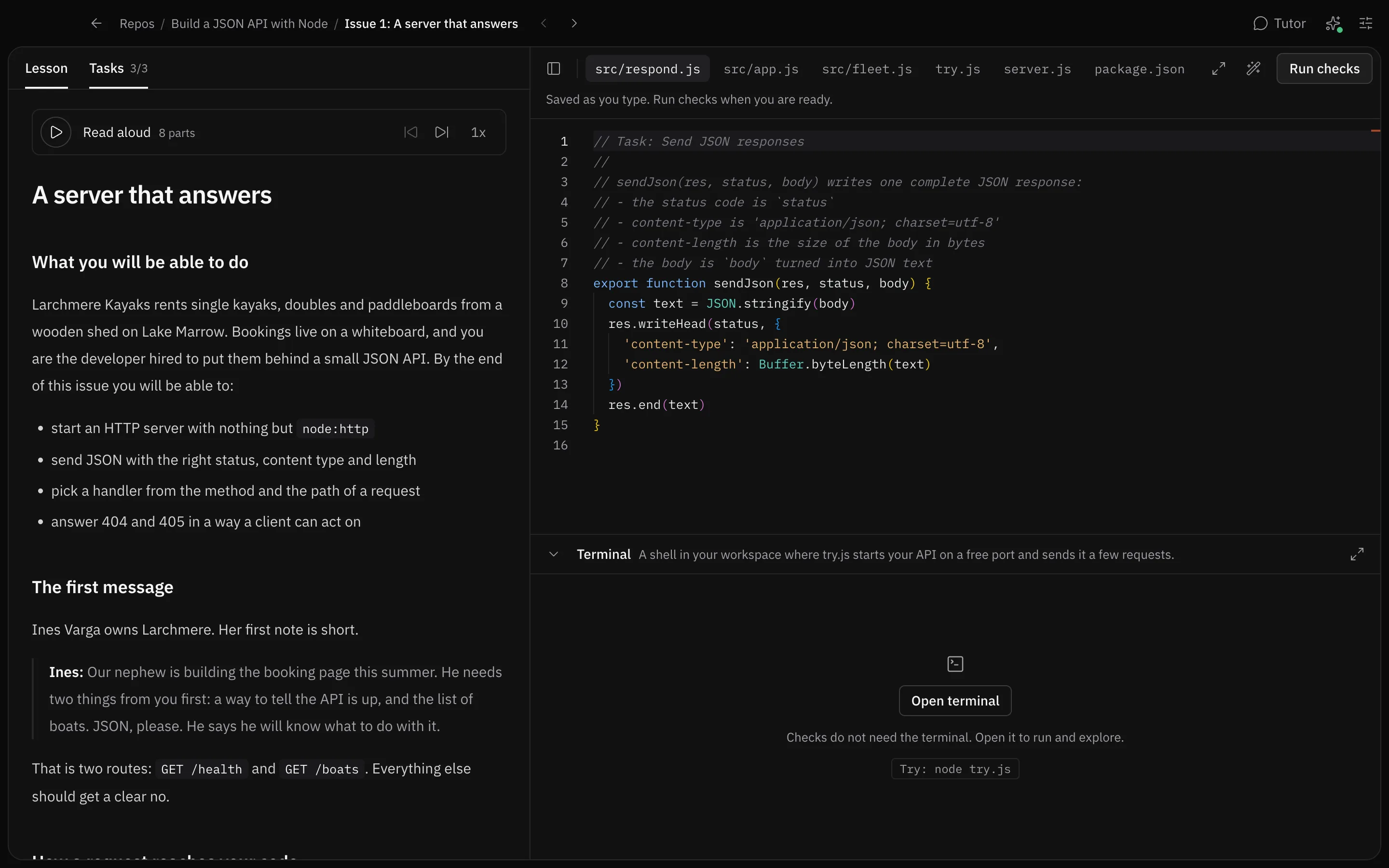
    No time to read? The lesson reads itself aloud, part by part.

    The lesson of the issue A server that answers, with a read aloud player above the heading and a short note from the owner of a kayak rental.
  2. 02

    Write the code

    The files you need open in a real editor, in a folder on your own disk. Your work is saved as you type.

    There is no fill in the blanks. You write the function the issue asks for, the way you would at work.

    The editor with src/respond.js open: a sendJson function that writes the status, the content type and the content length, then ends the response.
  3. 03

    Run it in the terminal

    A real shell sits under the editor, already in your workspace, with a command to try. Run your code and read what it prints.

    Use git, node or anything else you have installed. It is your machine.

    The terminal after node try.js: GET /health answers 200, GET /boats answers 200 with the fleet, GET /canoes answers 404 and DELETE /boats answers 405.
  4. 04

    Press Check

    Hidden tests run against your code. Each task turns green, or tells you in plain words what to look at, next to what your code produced.

    A task pays its points once, the first time it passes. The tests themselves never enter your workspace.

    The checks of the task Send JSON responses after pressing Check: four checks, each with a green mark and a link to what your code produced, above the Check button.

/help

Stuck is part of it. Help that does not hand you the answer.

Check messages say what to look at, never what to type. When that is not enough, hints open one at a time, and a tutor can talk it through with you.

Three hints per task

The first hint opens after three checks that are not all green, then one more with each check. They go from a nudge to almost there.

3. Say no clearly

3 checks, not all green

  • An unknown path answers 404 not_found
  • The 404 error has a message
  • A wrong method answers 405 method_not_allowed
  • The 405 lists the allowed methods
  1. Hint 1

    There are two different ways a lookup can miss here. Each one gets its own status.

  2. Hint 2

    Opens with your next check

  3. Hint 3

    Opens with the check after that

A real task and its first hint, from the repo Build a JSON API with Node.

A tutor that knows the issue

A chat on the side of the workspace that knows the issue you are on. Ask in plain words; it explains rather than answers. It runs on a coding CLI you already have installed, or on your own API key.

  • Claude Codeclaude
  • Codexcodex
  • OpenCodeopencode
  • Gemini CLIgemini
  • Your own API key
  • Inline suggestionsOff by default

No sign-in to Indent. The tutor uses what you already have.

/local first

Local first, on purpose. Nothing to sign up for, nothing to keep online.

Indent is a desktop app, not a website you log in to. Your code runs with your own Node, in your own shell, on your own machine.

  • Everything is on disk

    Lessons, the files you write and your progress all live in folders on your computer. Each issue gets its own workspace, and the hidden tests stay outside it.

  • No account

    Open the app and start. There is no sign-in, no server and nothing to sync. Your points, levels and streak are kept on disk too.

  • The local model works offline

    The LLM, retrieval, agents and evals repos talk to a small model inside the app instead of a paid API. It answers the same way every time, so the checks are repeatable, and it needs no key and no network.

  • Your own AI tools

    The tutor works through a coding CLI you already use (Claude Code, Codex, OpenCode or Gemini CLI) or through your own API key. Indent runs no model service of its own.

/patterns

18 algorithm patterns, animated. Watch the code and the data move together.

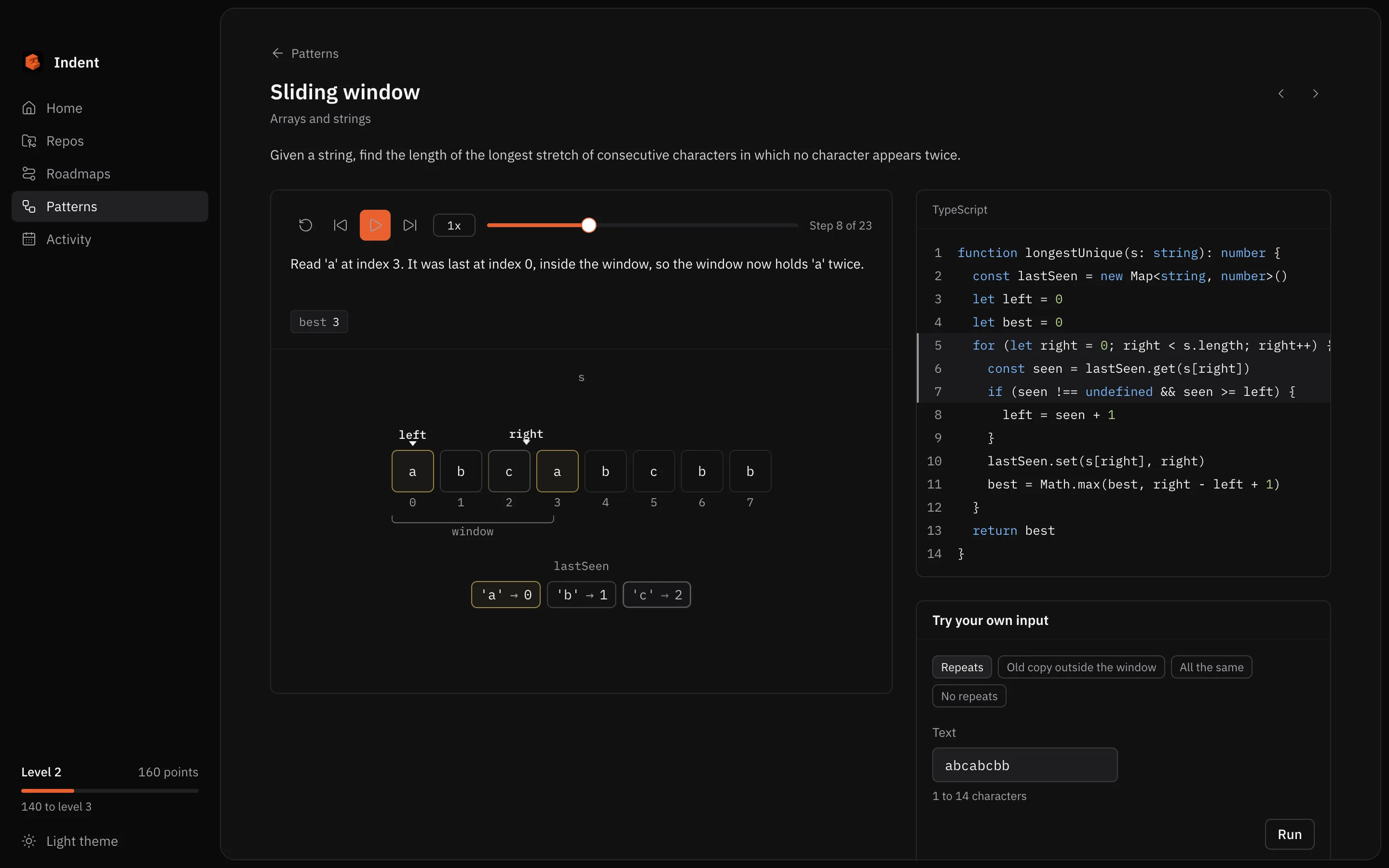
Each step lights up the line that runs, moves the pointers on the data, and says in a sentence what happened and why. Play, pause, scrub, change the speed, or try your own input.

The sliding window pattern at step 8 of 23: the string abcabcbb as cells with left and right pointers, and a map of last seen positions below.

Arrays and strings

  • Two pointersO(n)
  • Sliding windowO(n)
  • Binary searchO(log n)
  • Prefix sumsO(n) to build
  • Monotonic stackO(n)
  • Merge intervalsO(n log n)

Linked lists

  • Fast and slow pointersO(n)
  • Linked list reversalO(n)

Heaps and greedy

  • Top k with a heapO(n log k)
  • Greedy intervalsO(n log n)

Trees and graphs

  • Tree level orderO(n)
  • Tree depth firstO(n)
  • Shortest path in a gridO(rows × cols)
  • Topological sortO(V + E)
  • Union findO((n + m) α(n))

Recursion and dynamic programming

  • BacktrackingO(n · 2^n)
  • Dynamic programming in 1DO(n)
  • Dynamic programming in 2DO(n · m)

/roadmaps

Not sure where to start? A roadmap puts the repos in order.

Each roadmap is a set of repos toward one goal, in stages that build on each other. Follow one from the top, or skip what you already know.

  • AI engineer with TypeScript

    Call models, ground them in your data, give them tools, and measure the result

    1. 01

      The language

      TypeScript, the parts you use daily

      Async JavaScript without surprises

    2. 02

      Calling models

      LLM apps from scratch

    3. 03

      Your own data

      Retrieval from scratch

    4. 04

      Tools and agents

      Build an agent by hand

    5. 05

      Knowing it works

      Evals: measure before you ship

      LLM bug hunts

    5 stages, 33 issues, 99 tasks

  • Backend developer with Node.js

    From the language to an API with a database behind it

    1. 01

      JavaScript

      JavaScript foundations

      Async JavaScript without surprises

    2. 02

      TypeScript

      TypeScript, the parts you use daily

    3. 03

      An API

      Build a JSON API with Node

    4. 04

      Data

      SQL for everyday questions

    5. 05

      Working with git

      Git rescues

    5 stages, 27 issues, 78 tasks

  • Frontend from the page up

    A page people can use, the code that makes it move, then components

    1. 01

      The page

      Web pages that hold up

    2. 02

      The language

      JavaScript foundations

      Async JavaScript without surprises

    3. 03

      Pages that respond

      JavaScript in the browser

    4. 04

      Components

      React, one screen at a time

    4 stages, 22 issues, 66 tasks

  • Interview prep

    The language questions and the bug stories interviewers ask for

    1. 01

      Language questions

      JavaScript foundations

      TypeScript, the parts you use daily

      Async JavaScript without surprises

    2. 02

      Bug stories

      JavaScript bug hunts

      LLM bug hunts

    2 stages, 20 issues, 60 tasks

/activity

Progress you can see. Points, levels and a streak, kept honest by the tests.

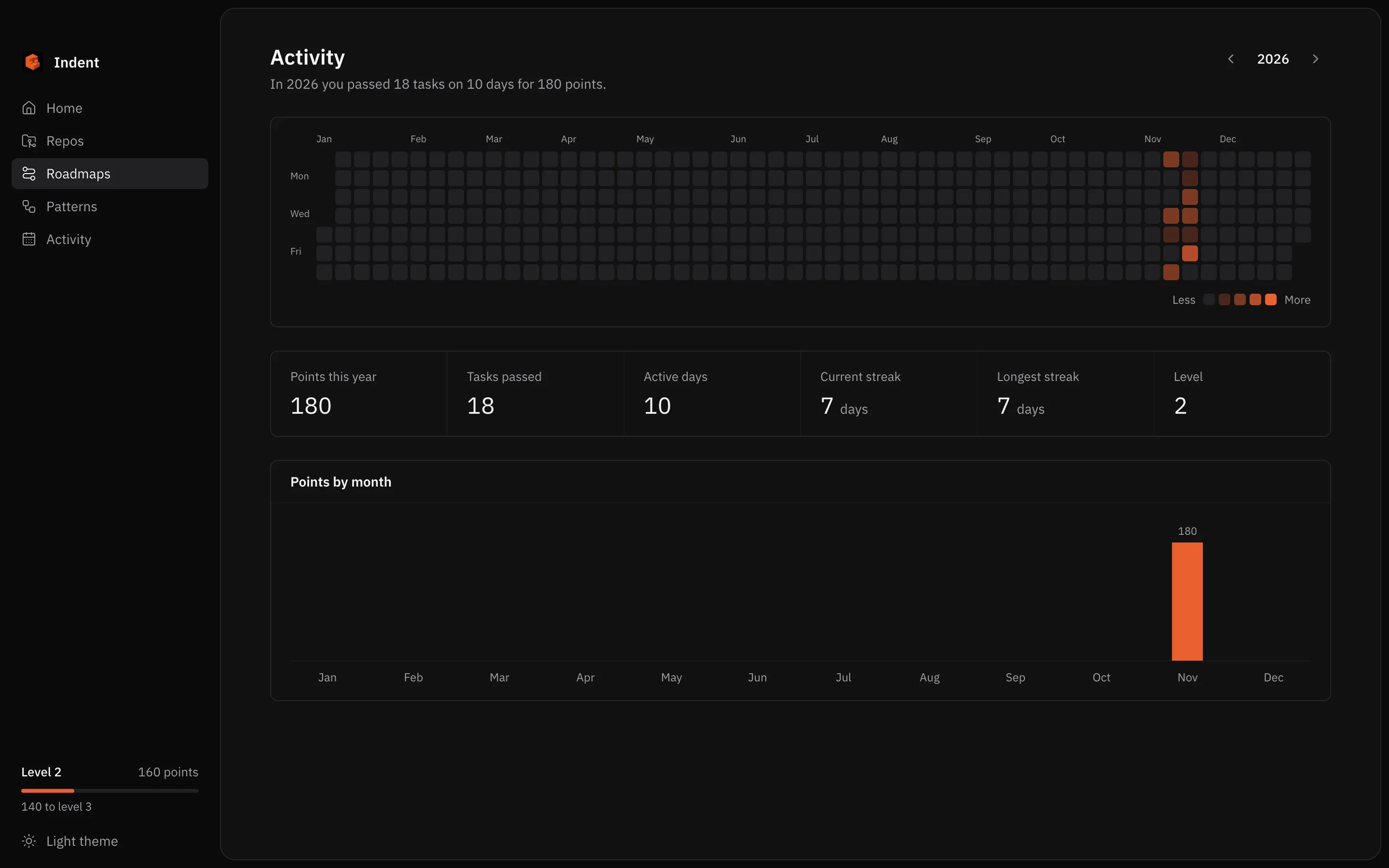
A task pays its points once, the first time it passes. Every day you pass one fills a square on the board and keeps your streak going.

The last months of the activity board, with a few orange squares in November, and the points, tasks and streak figures below.

/faq

Questions, answered plainly.

What people ask before they install a learning tool that runs on their own machine.

Do I need an account?

No. There is no sign-in and no server. You open the app and start a repo.

Does it work without internet?

Yes, once it is set up. The first Check installs the test tools into the app’s data folder, once. After that every repo runs offline, including the ones about language models, which talk to the local model inside the app. Only the tutor needs whatever network its CLI or API key needs.

Do I need an API key?

No. The LLM, retrieval, agents and evals repos run against the local model, an offline stand-in for a model API that answers the same way every time. A key is one of two ways to power the optional tutor; the other is a coding CLI you already have installed.

Which platforms does it run on?

macOS, on Apple Silicon and on Intel. There are Windows and Linux installers too; they are new and less tested. Indent runs your code and the checks with Node.js 22.18 or newer, and downloads its own copy if your computer has none.

Which languages can I learn?

HTML and CSS, JavaScript in the browser and React, each with the page live beside your code. JavaScript and TypeScript, including async code and a JSON API with plain Node. SQL on built-in SQLite. Git, in the real terminal. The AI repos (LLM apps, retrieval, agents, evals) are written in TypeScript.

Where is my work stored?

In folders on your computer. Each issue has its own workspace with the starter files, which you edit like any project. Your progress is stored locally too. The hidden tests are never copied into your workspace.

Will the hints or the tutor just give me the answer?

No. Check messages say what to look at in plain words and never give the answer. Hints open one at a time as you keep trying, and the tutor explains rather than writes the code for you.

Is it free?

There is nothing to buy or sign up for in Indent itself: no account, no server. If you use the tutor, any cost is between you and the provider behind your CLI or API key.

Pick a repo. Fix the first issue tonight.

Download Indent

One installer, nothing to sign up for. Indent runs your code and the checks with Node, and the first Check installs the test tools once, into the app’s data folder.

Version
0.1.0
System
macOS, Windows or Linux
Node.js
22.18 or newer, or Indent downloads it

Indent is not signed by Apple or Microsoft yet, so the first open needs one extra step. On macOS, open System Settings, Privacy and Security, and choose Open Anyway. On Windows, choose More info, then Run anyway.

Or build it yourself from the source on GitHub.